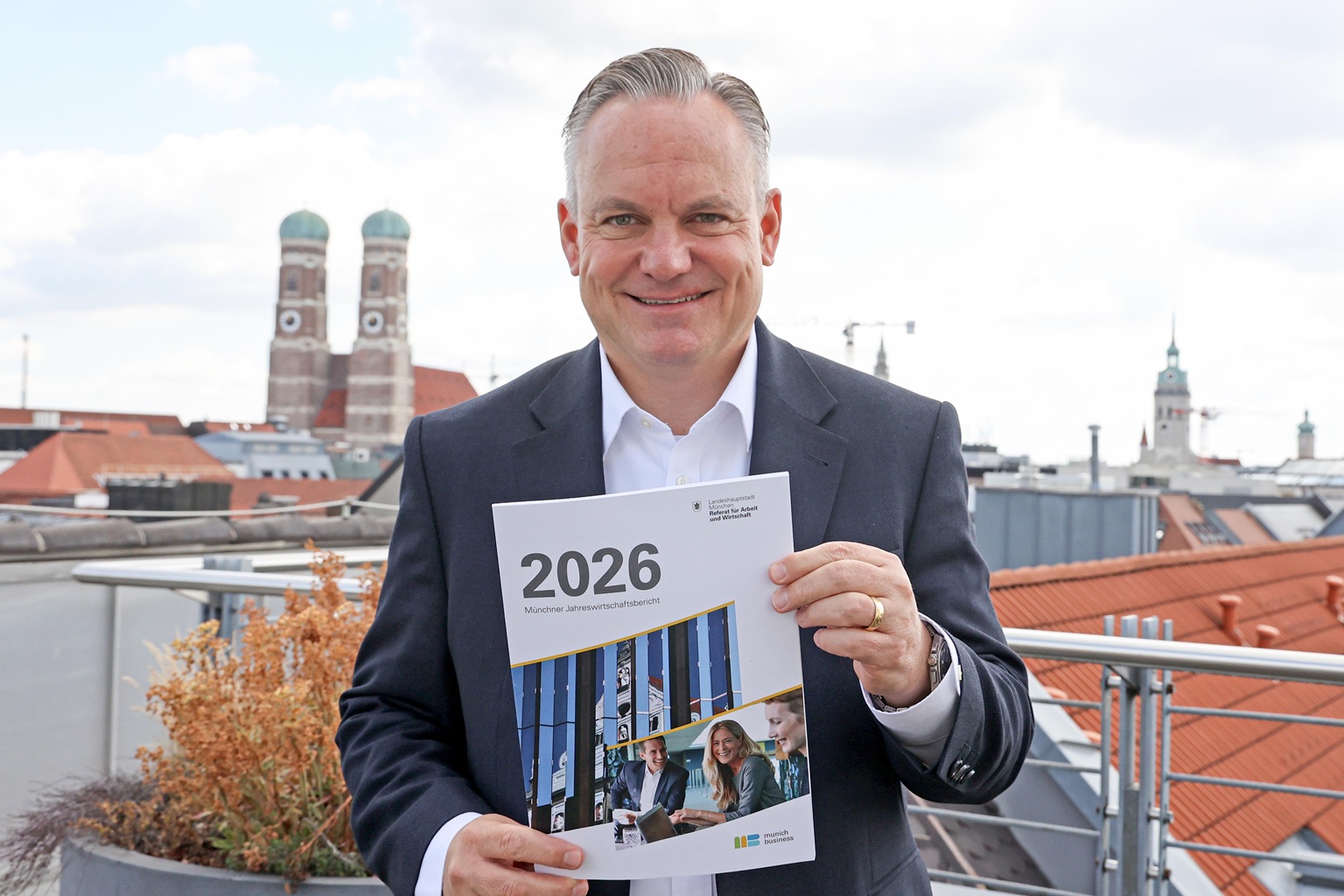
Resilience and innovation in challenging times
Macroeconomic conditions: Economic stagnation and geopolitical crises
Germany’s economy stagnated in 2025, with GDP growth of just 0.2 percent. Initial forecasts for 2026 called for an increase to 0.6 percent – but the outbreak of the Iran War in late February 2026 once again clouded the outlook and caused energy and commodity prices to skyrocket. Immediately after the provisional end of the war, the ifo Institute revised its forecast to 0.8 percent.
Munich as Bavaria’s economic engine
Munich generates 19.0 percent of Bavaria’s GDP, even though only 11.4 percent of Bavaria’s population lives there. In terms of labor productivity – measured by GDP per employed person – Munich, at 122,227 euros per employed person, is well ahead of Hamburg and Berlin.
The city is host to seven DAX-listed companies in the automotive, insurance, high-tech, and energy sectors–showing the range of Munich`s unique industry diversity.
Startup capital: Munich overtakes Berlin
In 2025, Munich rose to first place among German startup launches:
- With 19.3 new startups per 100,000 residents, Munich is well ahead of Berlin (16.8) and Düsseldorf (15.4).
- Munich-based startups attracted 2.7 billion euros in venture capital (Berlin: 2.4 billion euros).
- The Munich ecosystem includes eight unicorns and two decacorns.
Munich’s job market: All-time high despite challenging conditions
Employment in Munich’s job market will reach a new maximum in 2025, with 976.230 employees registered for social security. This represents a 0.6 percent increase over the previous year. By comparison, employment growth last year in Bavaria and Germany was only 0.1 percent each.
However, due to stagnant economic growth, the unemployment rate also rose, averaging 5.0 percent for the year in the Munich employment agency district. Among Germany´s most populous cities, Munich remains the metropolis with the lowest unemployment rate (Berlin 10.3 percent | Cologne 9.1 percent | Hamburg 8.3 percent | Frankfurt 6.9 percent | Stuttgart 5.7 percent).
Municipal finances
Trade tax revenue amounted to 3.63 billion euros in 2025. Despite stable tax revenues, however, Munich’s debt rose to 7.3 billion euros in 2025 (+36 percent compared to 2024). Municipal investments are directed toward infrastructure, education, housing construction, climate and environmental protection and social services.